
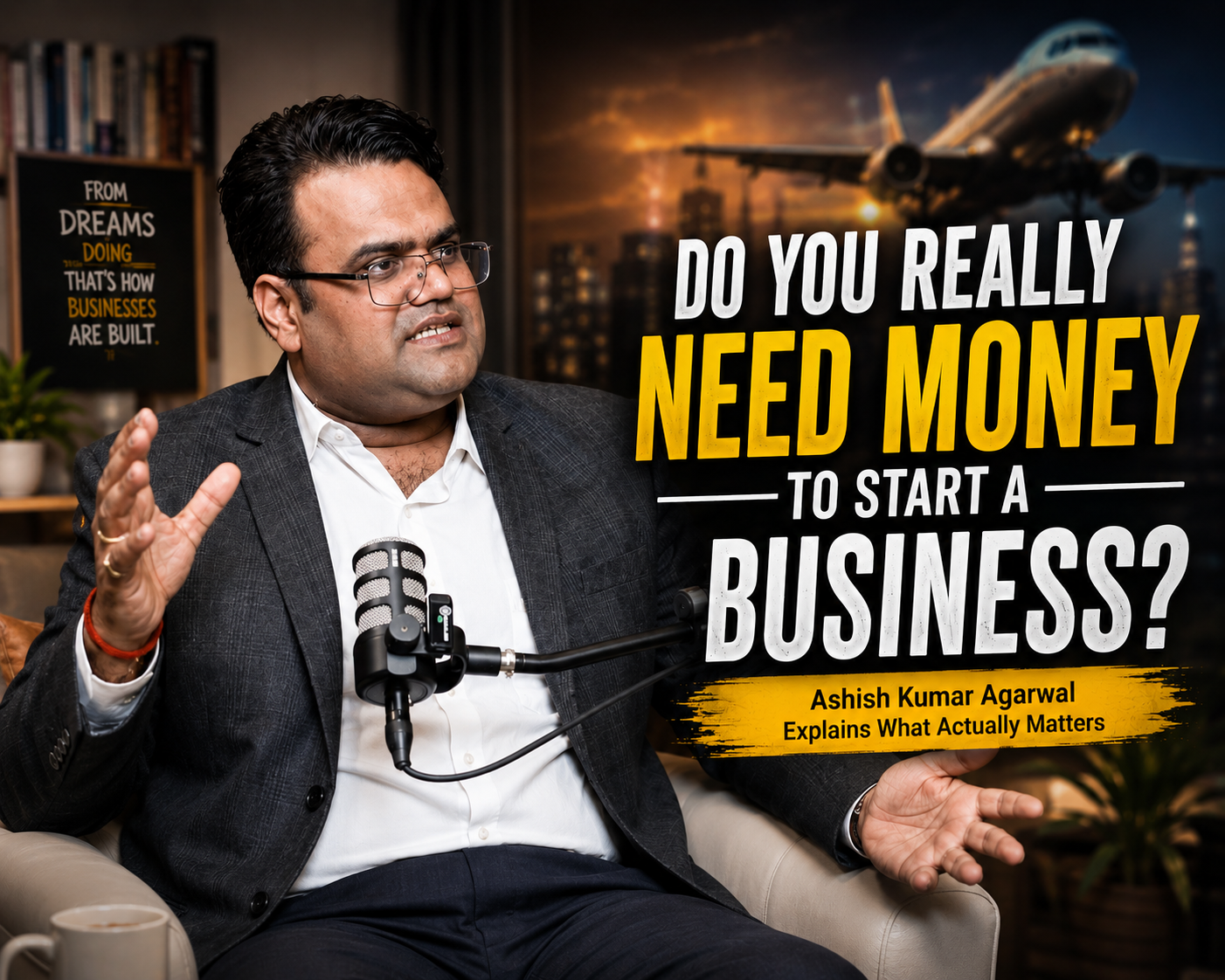
Do You Really Need Money to Start a Business?
One of the biggest reasons people postpone entrepreneurship is simple: “I don’t have enough money to start a business.”
But is money really the biggest requirement for starting a business?
But here is an important question: Do you really need a lot of money to start a business?
According to entrepreneur and business expansion expert Ashish Kumar Agarwal, money is important, but it is not necessarily the first thing an entrepreneur needs.
In a detailed conversation hosted by Sarvesh Mishra, Ashish explains that before worrying about investment, an aspiring entrepreneur should first develop the right mindset, understand the customer and identify what the business actually requires.
This does not mean that capital is unimportant. Every business needs resources at some stage. The real question is how much capital you need, when you need it and what you are going to use it for.
The First Question Should Not Be “How Much Money Do I Need?”
When people think about starting a business, they often begin with questions such as:
- How much money will I need?
- Do I need an office?
- Do I need employees?
- Do I need a website?
- Do I need expensive equipment?
- Do I need a large inventory?
These questions are understandable, but they may not be the best place to start.
A better starting point is: “What problem can I solve, and who is willing to pay me for solving it?”
Once you have clarity about the customer and the business model, you can work backwards and identify the resources you actually need.
Three Broad Ways to Start a Business
Ashish explains business models through three broad categories:
- Trading
- Manufacturing
- Services
Each model has different investment requirements.
-
Trading Business
A trading business generally involves buying products and selling them to customers. The entrepreneur may need suppliers, inventory, transportation, storage and a distribution or sales network. However, even within trading, the investment can vary significantly depending on the product and business model.
-
Manufacturing Business
Manufacturing usually requires higher initial investment. Machinery, raw materials, production facilities, employees, quality control, storage and other infrastructure can require substantial capital. For this reason, manufacturing may not always be the easiest model for someone starting with limited funds.
-
Service Business
A service business can sometimes be started with considerably less fixed investment. For example, instead of immediately setting up an office, hiring a team and purchasing equipment, an entrepreneur could connect customers with an existing service provider and earn a commission.
The entrepreneur is creating value through customer acquisition, sales, relationships and execution, rather than owning every resource involved in delivering the service.
This leads to an important business lesson: You don’t always need to own every resource required to create value.
Sometimes, you need to know how to connect the right resources with the right customers.
Can You Start a Business Without Money?
The honest answer is: it depends on the business.
Some businesses can be started with very little capital, while others require significant investment from day one. A manufacturing plant, restaurant or large retail outlet will obviously have different capital requirements from a consulting, brokerage, digital marketing or commission-based service business. So, instead of asking whether it is possible to start a business with zero money, ask:
“Can I start this particular business with the resources I currently have?”
You may already have some of the resources you need:
- Industry knowledge
- Relationships
- Sales ability
- Social media presence
- A laptop or smartphone
- Access to suppliers
- Existing customers
- Communication skills
- A professional network
- Time and willingness to learn
You Don’t Have the Skills? Learn, Outsource or Collaborate
Another common barrier is lack of skills.
Many people think: “I don’t know how to do this, so I cannot start the business.”
Ashish Kumar Agarwal shares his own experience of learning YouTube later in his career, despite having limited computer knowledge earlier. The broader lesson is useful for every entrepreneur: your current skill set does not have to define your future business. If you don’t know something today, you have several options.
Learn it: Today, entrepreneurs can learn many practical skills through online courses, videos, communities and hands-on experience.
Outsource it: You don’t necessarily have to become an expert in every function.
For example, you may understand sales and customer acquisition but not graphic design. You can work with a designer instead of spending months trying to become one.
Collaborate: Sometimes the best solution is to find someone whose strengths complement yours.
Start With a Customer Problem, Not Just a Business Idea
A business idea by itself has no guaranteed value. A business becomes valuable when it solves a problem that customers care about enough to pay for. Before investing heavily, an entrepreneur should understand the market.
Ask yourself:
- What problem am I solving?
- Who experiences this problem?
- How frequently does the problem occur?
- How are customers solving it today?
- What are they currently paying?
- What alternatives are available?
- Why would customers choose my solution?
- Can I deliver the solution profitably?
- Can I acquire customers at a sustainable cost?
These questions can reveal whether an idea has genuine business potential. For example, you may believe that a particular product is excellent. But if customers do not need it, do not understand its value or are unwilling to pay for it, the business may struggle regardless of how much money you invest.
Don’t Spend First. Validate First.
One of the most practical lessons for new entrepreneurs is to validate the business before making a large investment. Suppose you have an idea for a service.
Instead of immediately:
- renting an office,
- hiring a large team,
- buying expensive equipment,
- building a complex website and
- spending heavily on advertising,
India’s Digital Economy Has Changed the Starting Point
Technology has also changed the way entrepreneurs can start and grow businesses. Today, a business can communicate with customers, market its products, generate leads and build relationships online without necessarily starting with a large physical infrastructure.
India’s internet and broadband ecosystem has expanded significantly. TRAI reported that India’s broadband subscriber base crossed 1 billion in November 2025. For entrepreneurs, the broader opportunity is clear: digital channels can reduce some traditional barriers to reaching customers and building distribution.
Find a real problem. Create value. Reach the right customer. Sell effectively. Deliver consistently.
What Matters More Than Money When Starting a Business?
Money certainly matters, but several other factors can be equally important in the early stages.
- Mindset: Entrepreneurship requires the willingness to learn, experiment and deal with uncertainty.
- Customer Understanding: Knowing what customers actually want is more valuable than simply having a clever business idea.
- Sales Ability: A great product without customers is not a sustainable business.
- Execution: Ideas are common. Execution is where businesses are built.
- Adaptability: Markets change. Customer behaviour changes. Entrepreneurs need to be willing to change their approach as well.
- Resourcefulness: Instead of asking, “What do I not have?”, successful entrepreneurs often ask, “How can I get this done with the resources available to me?”
The Real Formula for Starting a Business
A simple way to understand the entrepreneurial journey is:
Problem → Solution → Customer → Revenue → Repeatability → Scale
Is Starting With Less Money Better?
Not necessarily. Having limited capital can force entrepreneurs to become creative, but having sufficient capital can also help a proven business grow faster. The important thing is capital efficiency.
An entrepreneur should know where every major investment is going and what outcome it is expected to produce.
Spending money simply because competitors are spending money is a different story.
Common Mistakes New Entrepreneurs Should Avoid
- Starting With Infrastructure
- Hiring Too Early
- Buying Too Much Inventory
- Focusing Only on the Product
- Waiting to Become “Perfect”.
Frequently Asked Questions
Do you need money to start a business?
Yes, most businesses require some resources and capital, but the amount varies widely. Some service-based and digital businesses can be started with relatively low initial investment, while manufacturing, retail and infrastructure-heavy businesses generally require more capital.
What is the best business to start with low investment?
There is no single best business for everyone. Service-based businesses, consulting, freelancing, brokerage and certain digital businesses can have lower initial infrastructure requirements, but success depends on demand, skills, customer acquisition and execution.
Can I start a business without experience?
Yes. You can learn skills, work with experienced people, outsource specialised tasks or start on a small scale. Lack of experience can be managed through learning and practical execution.
Should I get funding before starting a business?
Not always. If you can validate your business idea with limited resources, it may be better to test demand first and raise or invest more capital after you understand the business model.
What is more important: money or skills?
Neither should be viewed in isolation. Money provides resources, while skills help you use those resources effectively. Customer understanding, sales, execution and the ability to learn are also critical.
How can I start a business with limited money?
Start by identifying a problem, speaking with potential customers, testing a simple solution and generating your first revenue. Use existing resources where possible and invest more as the business model becomes clearer.
Final Takeaway: Money Can Accelerate a Business, But It Cannot Create Demand
So, do you need money to start a business?
Sometimes, yes. But you may not need as much money as you initially believe. Money can help you hire people, buy equipment, build infrastructure, market your business and scale faster. But money alone cannot guarantee customers, solve a weak business model or turn a poor idea into a successful company.
That is one of the key lessons from Ashish Kumar Agarwal’s conversation with Sarvesh Mishra:
Don’t wait until you have everything. First understand what the business actually needs—and then build from there.
For an aspiring entrepreneur, that shift in thinking can be more valuable than simply waiting for a bigger bank balance.